When Discipline Becomes a Cage
May 13, 2026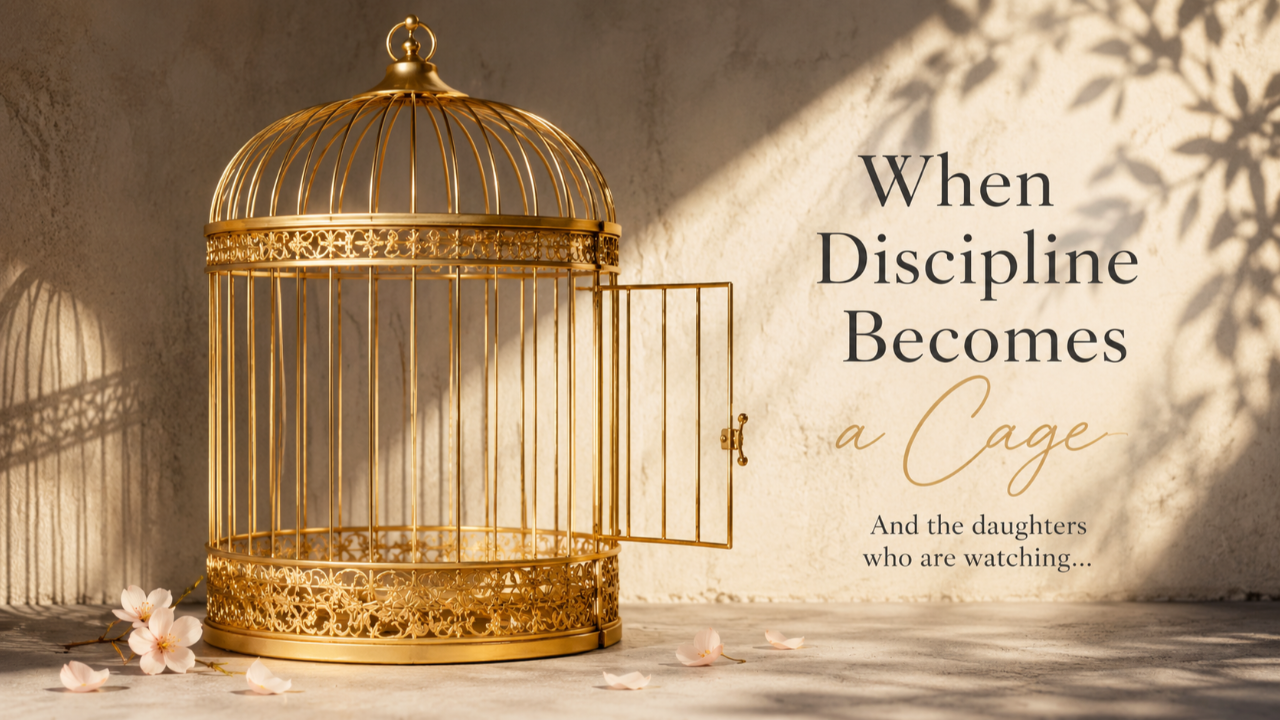
There is a question that has been sitting with me lately.
How many of us began trying to shrink ourselves before we even understood what our bodies were for?
I think about the girls who tried diets they found in magazines. Or thumbtacked pictures of impossibly perfect women to their adolescent walls (I did.)
The girls who learned that their value lived in a number on a scale. The girls who skipped lunch because that is what the other girls were doing. The girls who never felt safe in their own bodies again.
And I wonder how many of us lived some version of that story.
What the Research Shows
Developmental psychology shows something heartbreaking: girls who begin dieting in elementary or middle school carry the effects far beyond adolescence and into adulthood.
Early dieting predicts anxiety around food, confusion about hunger and fullness, higher risk of binge eating, chronic body dissatisfaction, and a belief that worth depends on being as small as possible.
But most of the girls in these studies were not dieting because they hated their bodies. They were dieting because they were trying to belong. To fit in. To be acceptable. To feel safe.
Weight and appearance became a source of approval. Thinness became the price of belonging. And a lot of us learned very young that if we could not control the chaos around us, maybe we could control our bodies.
The Two Prisons
Fast forward to adulthood, and that childhood wound splits women into what look like two completely different groups.
The women who struggle:
They restrict, then binge. They start strong Monday morning and fall apart by Wednesday night. They feel out of control around food and blame themselves. They are told they lack discipline.
What nobody sees is that food has become their refuge. Not because they want it to be, but because it feels safer than the feelings underneath. Restriction, overeating, and obsession are not moral failures. They are coping strategies that once helped a a young girl survive emotions she had no support for.
Shame. Fear. Hopelessness. The pressure to be perfect. The pressure to be pleasing. The pressure to take up less space.
The behaviors look chaotic, but they are serving a purpose: they numb the feeling of not being enough. The thing that provides escape also creates more shame, which requires more escape. The cycle continues.
The women who appear to succeed:
These are the women who manage to maintain the culturally approved body. The ideal weight. The lean, defined physique we are told to aspire to.
Social media celebrates them. People comment on their dedication. They become the example other women are told to follow. The viral posts of women back in pre-pregnancy jeans one month after giving birth. The women in their forties, fifties and beyond staying lean and defined. Culture rewards them with praise, admiration, and validation.
And that praise becomes part of their identity.
What most people never see is the pressure that praise creates. Once your worth becomes attached to your appearance, you feel like you have to stay camera ready at all times. You can't soften. You can't rest. You can't have an off day. You can't eat without thinking about how it will look tomorrow or whether it will start a spiral you cannot recover from.
Many women in these bodies are not as free as they appear. Some live with constant vigilance, constant comparison, and constant fear of losing the identity the world rewards. They're exhausted but cannot stop performing. They want to just be human again, but their worth feels tied to staying disciplined.
They're trapped too. Just in a prison that looks like success.
The Same Wound, Different Cages
Here is what I have come to understand: both groups are running from the same core belief.
I am not enough as I am.
One group uses food to soothe that belief. The other uses control and discipline. Both are trying to escape the same wound.
And culture pits them against each other. Lazy versus disciplined. Out of control versus inspiring. Failing versus succeeding.
When actually, they are fighting the same battle. They just landed in different prisons.
The devastating irony is this. The women held up as the standard are often suffering quietly. And the women who feel like they are failing are being measured against bodies that are not free either.
I know both of these prisons intimately. For decades, I was the fit, striving perfectionist. I got praised for my discipline. My professional credibility lived in how my body looked.
And I was exhausted.
Trapped in a performance I couldn't stop because my identity depended on it. I'm still unlearning those messages. Decades of conditioning doesn't disappear overnight.
But I never want to go back. The freedom I have found, still evolving, is worth more than all the praise I used to receive.
Why "Just Follow the Plan" Doesn't Work
A colleague told me recently about a client who has struggled with her weight her entire life and was struggling to stick with the plan she was given. My colleague asked, frustrated: "Why can't she just follow it?"
That question reveals everything wrong with how we approach food, bodies, and healing.
It assumes the problem is compliance. When actually, the behavior is protecting her from something the plan doesn't address.
People can't "just follow the plan" because the eating pattern is doing essential emotional work. It's providing something: comfort, control, numbing, maybe the only reliable source of relief she has ever had.
Taking it away without addressing what it protects is like removing someone's crutches before their leg has healed.
The compulsion feels more manageable than the feelings of not being enough. The binge, the restriction, the obsession feel safer than sitting with shame, fear, or the belief that they don't deserve to take up space.
This is why "eat less, move more" has never healed anyone. Contrary to what many fitness coaches would have you believe, the body isn't simply a math problem. It's an ongoing relationship.
And relationships heal through safety, understanding, and compassion. Not punishment and shame.
The Wound We Pass Down
Here is what makes this so urgent: we pass this wound to our daughters.
A mother who learned her worth lives in her body teaches her daughter the same lesson. Not because she is cruel, but because she is still trapped in it herself.
The daughter watches:
- Her mother skip meals or restrict food
- Her mother criticize her own body
- Her mother celebrate weight loss and mourn weight gain
- Her mother get praised for being disciplined
- Her mother receive love and attention when she is smaller and leaner
And the daughter learns: This is what women do. This is how we earn our place.
Even mothers who swear they will never put their daughter on a diet cannot fully protect her. She still absorbs the cultural messages. She sees what gets praised. She notices which bodies are celebrated and which are ignored. She watches the other girls at school start restricting.
She learns that thinness equals belonging, even if no one ever said it out loud.
And the women maintaining ideal bodies are often doing it for their daughters. Trying to be a role model. Trying to show that aging doesn't mean giving up. Trying to prove that women can stay relevant.
But what they actually model is that female worth expires if you don't fight your body's changes. That rest is failure. That value depends on controlling your appearance.
And the women struggling with disordered eating often hide it from their daughters. But the daughter still absorbs it through the secrecy, the shame, the way mom's mood rises and falls based on food or the scale.
Breaking the Cycle
This is not an individual failure. It is a cultural inheritance being passed down through generations.
We celebrate viral posts of women bouncing back after pregnancy. We praise the sixty year old with abs. We hold up disciplined bodies as moral victories. And we teach every watching daughter: This is what matters. This is what makes you worthy.
The most hopeful part of the research on early dieting is this. These patterns were learned, not permanent. The brain remains plastic. The body wants partnership, not perfection.
Healing begins the moment you understand why the behavior made sense in the first place. Compassion softens the shame. The shame loosens its grip. And the nervous system finally has space to learn a different way.
But individual healing is not enough. We have to stop participating in the programming.
We have to stop praising women for how quickly they bounce back.
We have to stop celebrating disciplined bodies as evidence of moral superiority.
We have to stop teaching girls that their worth lives in their waistlines.
We have to model that bodies are allowed to change, rest, soften, and age without losing value.
We have to show our daughters that food is not the enemy and their bodies are not problems to solve.
For the Women Reading This
If today's message stirred something in you, it's because part of you remembers when you started believing your body was a problem to solve.
Whether you are in the prison of disordered eating or the prison of disciplined performance, you are carrying a wound that was never yours to begin with.
You were not meant to spend your life fighting yourself.
You deserved to grow up trusting your body.
You deserved to feel safe.
And it is not too late to learn that now. It is not too late to teach the daughters watching, something different.
Take a breath before reading on. Let this land gently. There is nothing you need to fix today.
Reflection:
Did you start dieting young? Do you see echoes of those early messages in how you relate to food and your body today?
And if you have daughters, literal or figurative, what are they learning by watching you live in your body?